
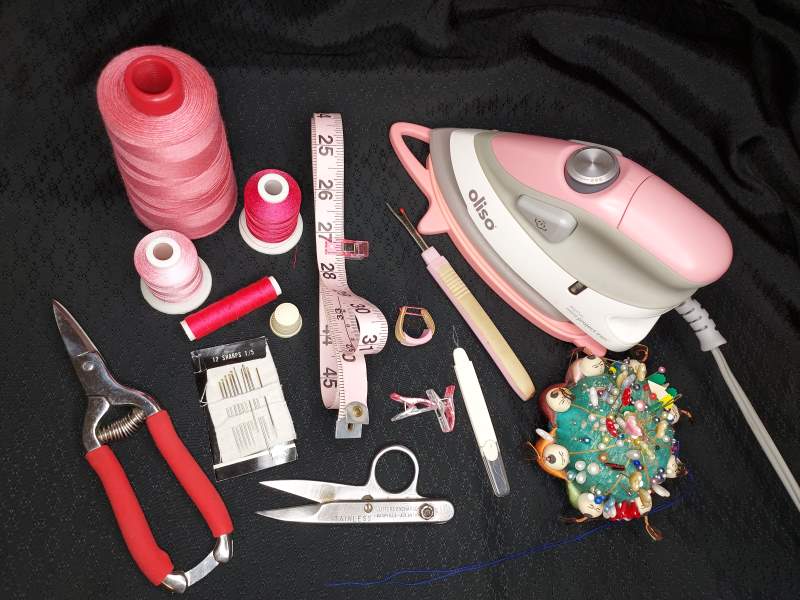
If you have decided to try sewing as a hobby or a career, here is some basic knowledge to get you started. First, you will need to acquire some tools, and depending on where you want to begin, will determine some of the tools and techniques you will need to start. For now, I will stick to the very basics of hand sewing and what you need to achieve that.
Sewing basics start with simple tools and hand stitching. Hand sewing is a good skill to learn as it will enable you to make repairs and do projects when a sewing machine is not available to you. A basic sewing stitch can create anything you want to create. You only need 5 or less things to get started…
I have provided links to Amazon for each of the items below. As an Amazon Associate, I earn from qualifying purchases.
With these items, you can create your first sewing project.
If you would like a sewing kit complete with everything you need to get started and then some, I am providing a link here to Amazon.
The best way to start any endeavor is to start with the basics and build from there. I will give you detailed steps and information along the way to help you get a good foundation in the creative, wonderful world of sewing.

Don’t think you need a sewing machine to achieve your sewing goals. Everything you want to sew can be done by hand. People have been hand-sewing garments, home decor, and crafts for centuries.
It is good to master hand sewing and then move on to other techniques that will increase your speed and up your quality. One of the most crucial tools needed for hand sewing is needles. Below are some quick reference charts of basic hand-sewing needles. But, before I get into needles, I want to first talk about thimbles
Thimble, Finger Protector
How do you push a needle through thick fabric? A thimble works best for this task. A thimble gives you more control of your needle when you are hand sewing which helps to avoid injury. A thimble not only assists when pushing a needle through thick fabric, but it also can speed up hand sewing when sewing through thinner fabrics.
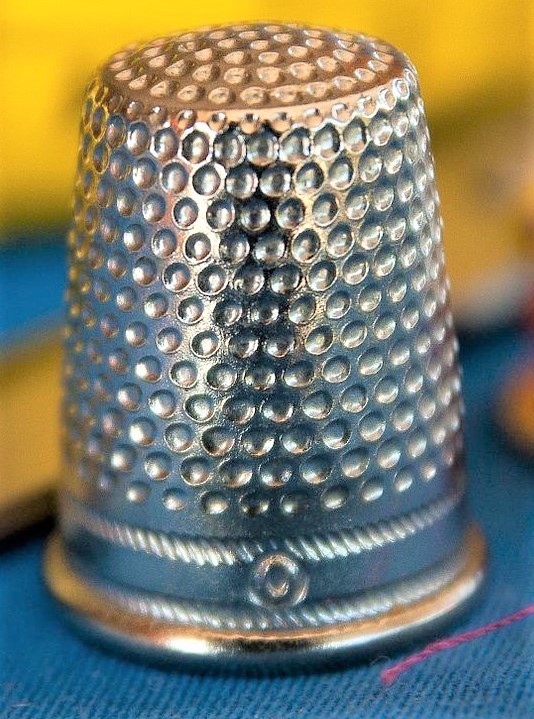
A thimble is a protective cover for your finger that enables you to push the needle through the fabric with no wear on your finger, it protects your finger when hand sewing. The most common thimble you may have seen is what looks like a tiny, tiny little metal cup that is pitted with dimples. These pits or dimples keep the needle from slipping as you push it through the fabric.

Not all thimbles are metal, thimbles come in other materials, such as leather, plastic, and some rubber-type materials. Find a thimble that best fits you and is suited to your needs, it will benefit your hand-sewing techniques. There is a learning curve to using a thimble, as with all new things, and you may choose to use different thimbles for different projects.
Which Finger Do You Put A Thimble On?
You want to wear a properly fitting thimble on the middle finger of your predominant hand. The hand, you will be using to push the needle through the fabric. The fit of the thimble is vital. Thimbles come in many different sizes, so finding a proper fitting one is possible. You may need a couple of different sizes of thimbles if your hands have a tendency to swell at times and you want to sew.
How do you ensure the thimble is a proper fit? Place the thimble on the middle finger that you will be pushing the needle through with, it should fit snugly but not too tight. Now put your hand down by your side and see if the thimble stays on. If it stays on and is not too tight then it is the perfect fit. If it falls off then it is time to look for a smaller thimble.
How To Use A Thimble For Hand Sewing?
A thimble is placed on the middle finger that will push the needle through the fabric. You will pinch the needle in between your thumb and forefinger and the thimble finger will curl in to engage with the back of the needle as you sew. The needle will generally hit the side of the thimble as it pushes the needle through the fabric. This position with the back of the needle engaging with the thimble is at its best with shorter needles. Longer needles will be too long for this position. If you are working with a longer needle, maybe place the thimble on your ring finger or consider a palm thimble.
Thimble For Long Nails

If you tend to wear your fingernails longer, wearing a traditional thimble will not work so well. There are options for this situation. A thimble that I like, not only for longer nails but also for keeping my finger from sweating is an open-sided thimble. This thimble gives your finger protection along with a lip that protects the back of your nail from needle slips. Now onto needles.
Hand Sewing Needles
It is important to get the best quality needles that you can afford. It will make your hand-sewing go by so much better. Some modern-day needles are made carelessly, so finding good quality new needles may be a challenge. If you run across some vintage sewing needles you might want to pick them up, they will be a great novelty addition to your sewing supplies collection and be of better quality than most newer needles.
Better quality needles are generally Japanese, British, or French-made. Europe seems to have better standards when it comes to manufacturing and producing consumer goods. True British needles, made in England are getting harder to find. One particular brand used to be solely made in England, but now they are made in China and inspected and finished in England. That brand is John James, but they are still better quality than most. I would steer clear of cheaper needles, they will only give you heartache.
Some of the better brands for hand sewing needles are…
- Bohin French-made
- Clover Japanese made
- John James/Roxanne British made
Needles made in Europe and Japan are the best needles to look for.
Here is a size chart below courtesy of Needles by John James. Also below is a chart of some common needles and their uses and standard sizes available.
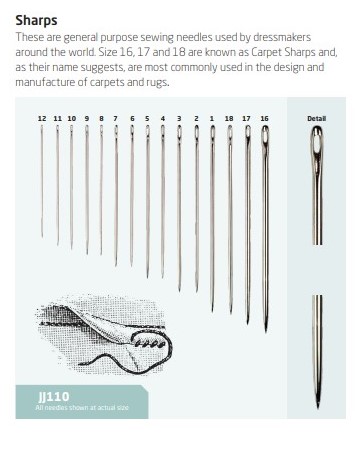
Needles by John James
Est. 1840
| Sharps | Medium length | General/All-purpose Sewing | Sizes 1-12 | For all-over general-purpose sewing projects. |
| Quilting/Betweens | Short length | Quilting | Sizes 1-12 | Ability to quickly stitch faster when quilting a quilt by hand |
| Ballpoint | Medium length | Use on knit fabrics | Sizes 5-10 | Rounded point to prevent runs in knit fabrics |
| Cotton Darners | Long length | Use with woven fabrics | Sizes 1-9 | For mending |
| Embroidery/Crewel | Medium length | Embroidery with the use of thicker thread | Sizes 1-12 | Decorative sewing using thicker threads |
To begin sewing, it is best to use Sharps, because they are a general, all-purpose needle that will work for almost all basic sewing projects. A size 10 or 11 for most fabrics will work, but if your fabrics are a little bit thicker, you may want to go to a size 9. The smaller the number, the larger the needle. Moving on to the next item you will need, which is scissors.
Scissors For Sewing
Scissors are a necessary tool when sewing. You need scissors to cut fabric, threads, elastics, velcro, zippers, paper, patterns, etc… Not one scissor does it all. For instance, you would not want to cut paper with your fabric scissors, and the scissors you use to cut paper will probably not suffice for cutting fabric.
Every sewist needs scissors that are specific to sewing. Having the right scissors will make all the difference when it comes to your sewing projects. The most important would be the fabric shears, and or fabric scissors. Also, a small pair of embroidery scissors for cutting threads and small cutting jobs would be useful. You could use your fabric shears to cut threads, but don’t ever use them to cut anything else! It is best to keep the fabric shears as sharp as possible and only use them for fabric. Sharp shears will ensure the precision cutting of fabric. Tip: To keep others from using your special fabric scissors on things other than fabric, put a padlock through the finger holes and hide the key.
Scissors For Cutting Fabric
I feel confident if you are reading this right now you know what a pair of scissors look like, but you may be wondering why there are so many different kinds. Each kind has a purpose, and knowing the purpose of certain scissors that you will be using is important when it comes to sewing because it will make your experience so much better. The right tool for the job makes a world of difference when it comes to getting the job done right.
Let’s start with scissors for cutting fabric. What are fabric scissors called? Fabric scissors are also referred to at times as Fabric Shears, Dressmaker Shears, or Tailor Shears. Tailor shears traditionally are shorter and stout to cut many layers of thicker fabrics. Dressmaker shears are very similar to tailor shears but sometimes have a much longer, slender blade. Fabric shears in general have a larger handle grip on one side and a smaller handle grip on the other. The smaller is for your thumb and the larger is for a few of your fingers. This grip gives you better control of the scissors when cutting fabric.

Can you use regular scissors to cut fabric? I would say in a pinch, yes, if the scissors are very sharp, but for the most part, NO. Regular scissors for general purposes just won’t have the sharpness to cut precisely. It will be difficult to get straight non-jagged lines. Fabric scissors are designed in a way that enables you to cut fabric more precisely, especially when you are cutting out a pattern.
Fabric shears have a bend that allows the scissors to glide against a flat surface while cutting. This helps you have more control while cutting and get a straighter cut.
Scissors For Cutting Thread
You can use just about any kind of scissors to cut threads as long as it is sharp enough, but some scissors work better than others. Embroidery scissors seem to be the go-to scissors for many sewists, but my go-to is thread nippers. They are spring-loaded and easier to grab and cut than embroidery scissors.

Thread
If you are thinking sewing thread is as simple as one choice, that is not the case. There are many different sizes and types for different applications, from the basic construction of fabric to decorative embroidery threads. Picking the right thread will ensure success in your work, but some choices are just that, a matter of choice.
For the sake of simplicity, it is okay to start your sewing adventures with all-purpose threads. All-purpose treads are usually a polyester or a polyester blend of cotton, they are stronger than 100% cotton and will hold up longer. Unless you are doing antique couture or something that requires 100% cotton, a poly-cotton blend will work best. The labels on the threads will give you information about what type of thread it is. A general all-purpose thread is a good beginner thread for hand sewing and sewing machines.
When it comes to your first sewing project, you will need fabric, and there are many, many different kinds of fabrics to choose from. Some fabrics are easier to work with and when you are just starting it is best to use ones that are easier to work with. Here I will talk about basic cotton fabric to get you started.
Fabric
The best fabric to start with is quilting cotton. It has a large selection of colors and prints and it is a stiffer fabric that is very easy to work with. Quilting cotton is 100% cotton and has a basic weave, meaning every thread is woven under and over the warp threads.
Warp threads are threads or yarn that run lengthwise or longitudinal in a piece of fabric and are stationary threads with tension that are strung on a loom. A loom can be as simple as four slender pieces of wood secured into a square and yarn wrapped around it.

Weft threads, sometimes called fill or filling yarn are the threads that get woven onto the warp threads, and in a basic weave, the weft threads go over and under each warp thread.
Another good beginner fabric to work with for practice is muslin. Muslin is inexpensive and it is a basic weave of cotton fibers. Muslin comes in different weights, from light sheer to heavier coarser weights, generally in white if it is bleached and shades of white if it is not bleached or left in its natural state.
To get started with the basic steps of hand sewing, go to my post Hand Sewing Stitches And Their Uses.